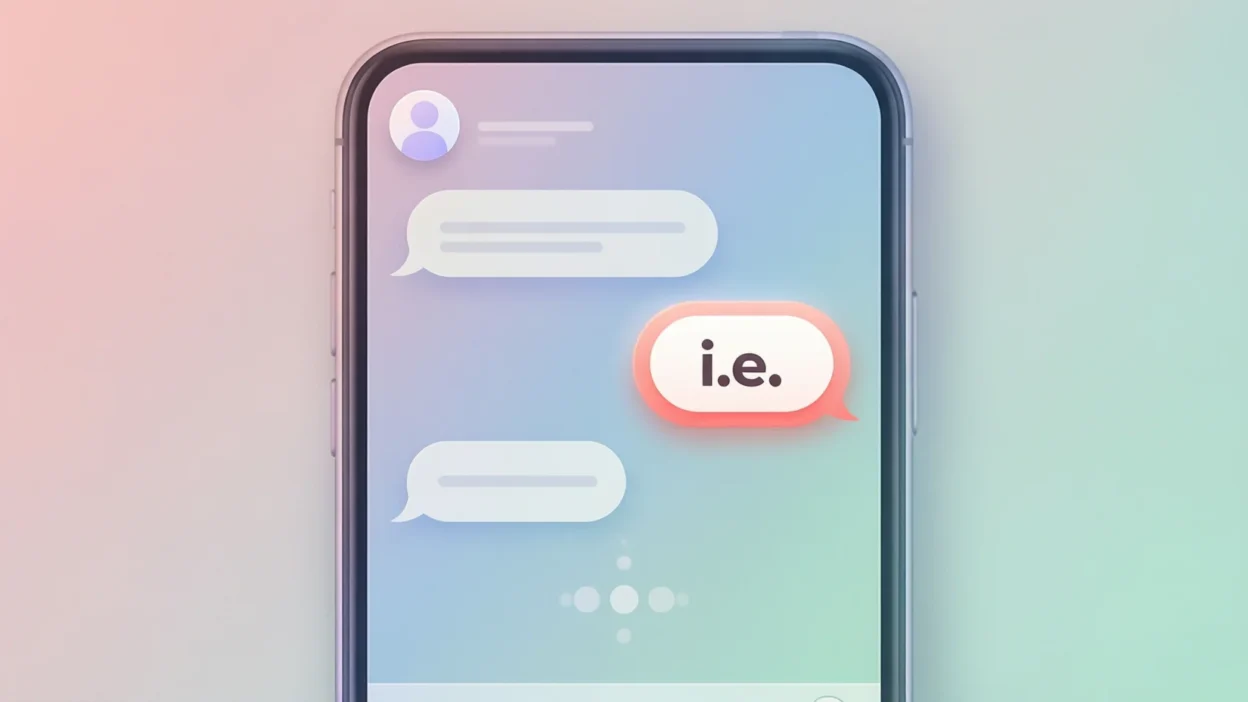
Have you ever been scrolling through a comment section, reading a school note, or chatting with someone online and suddenly saw “i.e.” pop up? The first time most people see it, it feels confusing. It looks short, formal, and kind of out of place next to emojis and casual text. You might wonder, Is this slang? Is it an abbreviation? Did I miss a memo?
Maybe you ignored it at first. Or maybe you Googled it mid conversation just to keep up. Don’t worry you’re not alone. This tiny term shows up everywhere, from school assignments to social media captions, and once you understand it, it actually makes things clearer.
Quick Answer:
“i.e.” means “that is” and is used to explain or clarify something more specifically.
What Does i.e. Mean in Text and Writing?
i.e. comes from the Latin phrase “id est,” which literally means “that is.”
In plain English, i.e. is used to restate something in a clearer, more specific way. It tells the reader, “Let me explain exactly what I mean.”
People use i.e. because:
- It helps avoid confusion
- It gives a clear explanation
- It sounds precise and confident
- It saves time instead of writing long explanations
Simple example sentence:
- we need to meet on a weekday, i.e., monday or tuesday.
Notice how the part after i.e. explains exactly what “weekday” means here.
Bold summary: i.e. means “that is” and is used to clarify or explain something more precisely.
Where Is i.e. Commonly Used Online?
You’ll see i.e. in many places, both online and offline. It’s not slang, but it’s also not outdated.
Common places you’ll see i.e.:
- Text messages (especially explanatory ones)
- Social media captions
- Comments and replies
- DMs on Instagram, Twitter/X, or Facebook
- School assignments and notes
- Emails and work messages
- Online forums and Reddit posts
Tone and vibe:
- Neutral to slightly formal
- Not playful or slangy
- Works in both casual and professional writing
- Less common in very short, fast chats
In texting culture, i.e. is usually used when someone wants to be extra clear, not casual or funny.
Realistic Text and Chat Examples Using i.e.
Here are some natural, modern examples written the way people actually type online:
- let’s meet somewhere quiet, i.e., not the mall
- he wants a simple gift, i.e., something useful
- we need one more person, i.e., you
- i can only hang out on weekends, i.e., saturday
- she likes classic movies, i.e., black and white ones
- the deadline is next week, i.e., before friday
- bring your id, i.e., passport or license
- he moved nearby, i.e., two streets away
These examples show how i.e. adds clarity without adding extra sentences.
When to Use i.e. (and When Not to)
Using i.e. correctly makes your message clearer. Using it wrong can confuse people.
✅ When to use i.e.
- When you want to clarify one exact meaning
- When explaining a general idea with specifics
- In writing where accuracy matters
- When the explanation replaces the original phrase
❌ When not to use i.e.
- When listing multiple examples (use e.g. instead)
- In super casual or playful texts
- When the meaning is already clear
- If you’re unsure and guessing
Small comparison table
| Context | Example phrase | Why it works / doesn’t |
|---|---|---|
| Clarifying | a close friend, i.e., my bestie | works because it explains exactly |
| Listing examples | fruits, i.e., apples and bananas | doesn’t work (should be e.g.) |
| Formal writing | required documents, i.e., id proof | works well |
| Casual chat | lol i.e. idk | feels awkward |
i.e. vs e.g. (Common Confusion)
This is one of the biggest misunderstandings in texting and writing culture.
- i.e. = that is (exact meaning)
- e.g. = for example (some examples, not all)
Quick comparison:
- bring a fruit, e.g., apples or bananas just examples
- bring a fruit, i.e., an apple only apple
If you can replace it with “that is,” use i.e.
Similar Terms and Alternatives to i.e.
If i.e. feels too formal, there are other ways to say the same thing depending on tone.
Common alternatives:
- that is full English version, neutral
we need one thing, that is, time - in other words more conversational
he’s unavailable, in other words, busy - meaning casual explanation
she wants space, meaning alone time - aka informal, name based
my brother, aka the loud one - which means friendly and clear
it’s delayed, which means we wait
Each option fits different texting situations. i.e. is best when you want clarity without extra words.
FAQs About What i.e. Means
1. Is i.e. slang?
No. i.e. is not slang. It’s a traditional abbreviation from Latin, still widely used today.
2. Is i.e. formal or informal?
It’s neutral. It works in both formal writing and casual explanations, but may feel stiff in playful texts.
3. Do people still use i.e. in texting?
Yes, especially when explaining something clearly. It’s common in thoughtful or detailed messages.
4. Can i.e. be used on social media?
Absolutely. You’ll see it in captions, comments, and long posts where clarity matters.
5. Is i.e. the same as “for example”?
No. i.e. explains exactly, while for example gives options.
6. Should I put a comma after i.e.?
Yes. Standard usage includes a comma: i.e.,
7. Can kids or teens use i.e.?
Yes, but it’s more common among students, professionals, or people used to writing.
Final Thought
So, what does i.e. mean? In simple terms, it means “that is” and helps make your message clearer by explaining exactly what you mean. It’s not slang, not outdated, and not complicated once you understand it.
In today’s fast-moving texting culture, clarity matters. Knowing how to use i.e. correctly can make your messages sharper, more confident, and easier to understand If you’re texting a friend, posting online, or writing something important.