
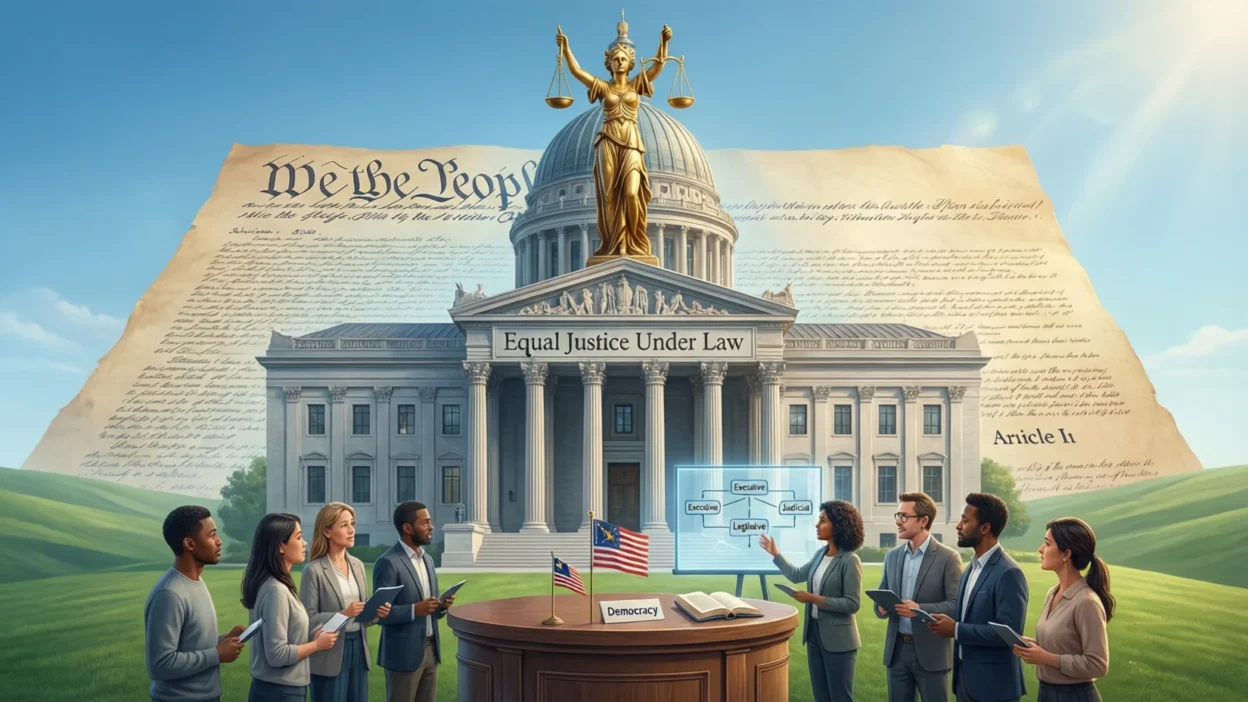
I still remember the first time I saw the words “judicial branch” online. It was in a comment under a viral post about a court case. People were arguing back and forth, throwing around big terms like checks and balances and constitutional law.
I paused and thought, Wait what does the judicial branch actually do? If you’ve ever heard it in a class, a news clip, or even a heated group chat debate and felt unsure, you’re not alone. Let’s break it down in the simplest way possible no law degree needed.
Quick Answer:
The judicial branch interprets the law, settles legal disputes, and decides if laws follow the Constitution.
What Does the Judicial Branch Do? (Meaning Explained in Plain English)
The judicial branch is one of the three main branches of government in the United States. Its job is to interpret the law, not make it or enforce it.
Plain-English explanation
Think of the judicial branch as the referee of the government. When there’s an argument about what a law means, or whether a law is fair or constitutional, the judicial branch steps in and makes the final call.
Is there a full form?
No. The judicial branch is not a texting abbreviation or slang term. It’s a formal government term used in civics, law, education, and news.
Why people talk about it
People mention the judicial branch when:
- A big court case is in the news
- A law is challenged as unfair or unconstitutional
- Someone wants to understand how government power is balanced
Short example sentence
“the judicial branch decides whether that law follows the constitution.”
Bold summary: The judicial branch explains what laws mean and decides if they are constitutional.
What Are the Main Jobs of the Judicial Branch?
The judicial branch has several key responsibilities that keep the legal system fair and balanced.
1. Interpreting laws
Laws can be confusing or unclear. The judicial branch explains how laws should be understood and applied in real situations.
2. Settling disputes
When people, businesses, or governments disagree, courts step in to resolve conflicts peacefully.
3. Reviewing laws
Courts can decide if a law violates the Constitution. This power is called judicial review.
4. Protecting rights
The judicial branch helps protect individual rights by making sure laws and government actions are legal.
Each of these roles helps prevent one branch of government from becoming too powerful.
Who Is Part of the Judicial Branch?
The judicial branch is made up of courts and judges.
Supreme Court
- The highest court in the country
- Has 9 justices
- Makes final decisions on major constitutional issues
Lower federal courts
- District courts
- Courts of appeals
These courts handle most federal cases and appeals.
Judges are expected to remain neutral, fair, and focused only on the law—not politics or popularity.
Where Is the Term “Judicial Branch” Commonly Used?
Unlike texting slang or chat shorthand, judicial branch is a formal term.
Common places you’ll see it:
- School textbooks and homework
- News articles and headlines
- Social media discussions about law or politics
- Online forums debating court decisions
- Educational videos and explainers
Tone
- Formal to neutral
- Not casual or slang
- Used in serious or informational contexts
You probably won’t see it in memes or playful DMs, but it does pop up in thoughtful online discussions.
Realistic Conversation Examples (Modern Chat Style)
Here are some natural, lowercase chat-style examples showing how people actually talk about it online:
- “wait, doesn’t the judicial branch decide if that law is even legal?”
- “the judicial branch can strike it down if it breaks the constitution.”
- “people forget the judicial branch isn’t supposed to make laws.”
- “this is why the judicial branch matters so much.”
- “the court ruling came from the judicial branch, not congress.”
- “checks and balances exist because of the judicial branch.”
- “the judicial branch keeps the other branches in line.”
- “that case went all the way to the supreme court, which is part of the judicial branch.”
When to Use and When Not to Use the Term
✅ Do use it when:
- Talking about courts or judges
- Explaining government structure
- Discussing constitutional issues
- Writing school assignments or essays
❌ Don’t use it when:
- Chatting casually with no legal context
- Replacing slang or abbreviations
- Making jokes where simpler words work better
Quick comparison table
| context | example phrase | why it works or doesn’t |
|---|---|---|
| school essay | “the judicial branch interprets the law” | clear and correct |
| news comment | “the judicial branch reviewed the case” | fits formal tone |
| casual joke | “the judicial branch says no lol” | tone mismatch |
| group chat debate | “the judicial branch can overturn it” | informative and useful |
Similar Terms and Related Concepts
Here are some related words people often confuse with the judicial branch.
| term | meaning | when to use |
|---|---|---|
| supreme court | highest court in the u.s. | when discussing final rulings |
| federal courts | lower national courts | for trial and appeal cases |
| checks and balances | system limiting power | explaining government structure |
| judicial review | power to reject laws | legal or academic context |
| constitution | highest law of the land | when talking about rights |
These are not slang terms but important civics concepts that often appear together.
Why the Judicial Branch Is Important in Everyday Life
Even if you never step into a courtroom, the judicial branch affects you.
It helps decide:
- Free speech rights
- Privacy protections
- Fair trials
- Equal treatment under the law
Without it, laws could be enforced unfairly or abused by those in power.
Frequently Asked Questions (FAQs)
1. Is the judicial branch the same as the courts?
Yes. The judicial branch is made up of all courts, including the Supreme Court and lower federal courts.
2. Does the judicial branch make laws?
No. It interprets laws. Congress makes laws, and the executive branch enforces them.
3. Is the term “judicial branch” slang?
No. It’s a formal government term, not social media slang or chat shorthand.
4. Why is the judicial branch independent?
Independence helps judges make fair decisions without political pressure.
5. Do judges work for the president?
No. Judges are separate from the executive branch, even though some are appointed by the president.
6. Can the judicial branch stop a law?
Yes. If a law violates the Constitution, courts can declare it unconstitutional.
7. Is the judicial branch talked about on social media?
Yes, especially during major court cases or Supreme Court decisions, but usually in a serious tone.
Final Thought
So, what does the judicial branch do? In simple terms, it explains the law, settles disputes, and protects the Constitution.
It may sound formal, but its impact is very real shaping rights, freedoms, and fairness in everyday life. The next time you see the term online or hear it in a debate, you’ll know exactly what it means and why it matters.